After a month and a half, and over 100 hours of effort, the CIU Galaxy Finder is here!
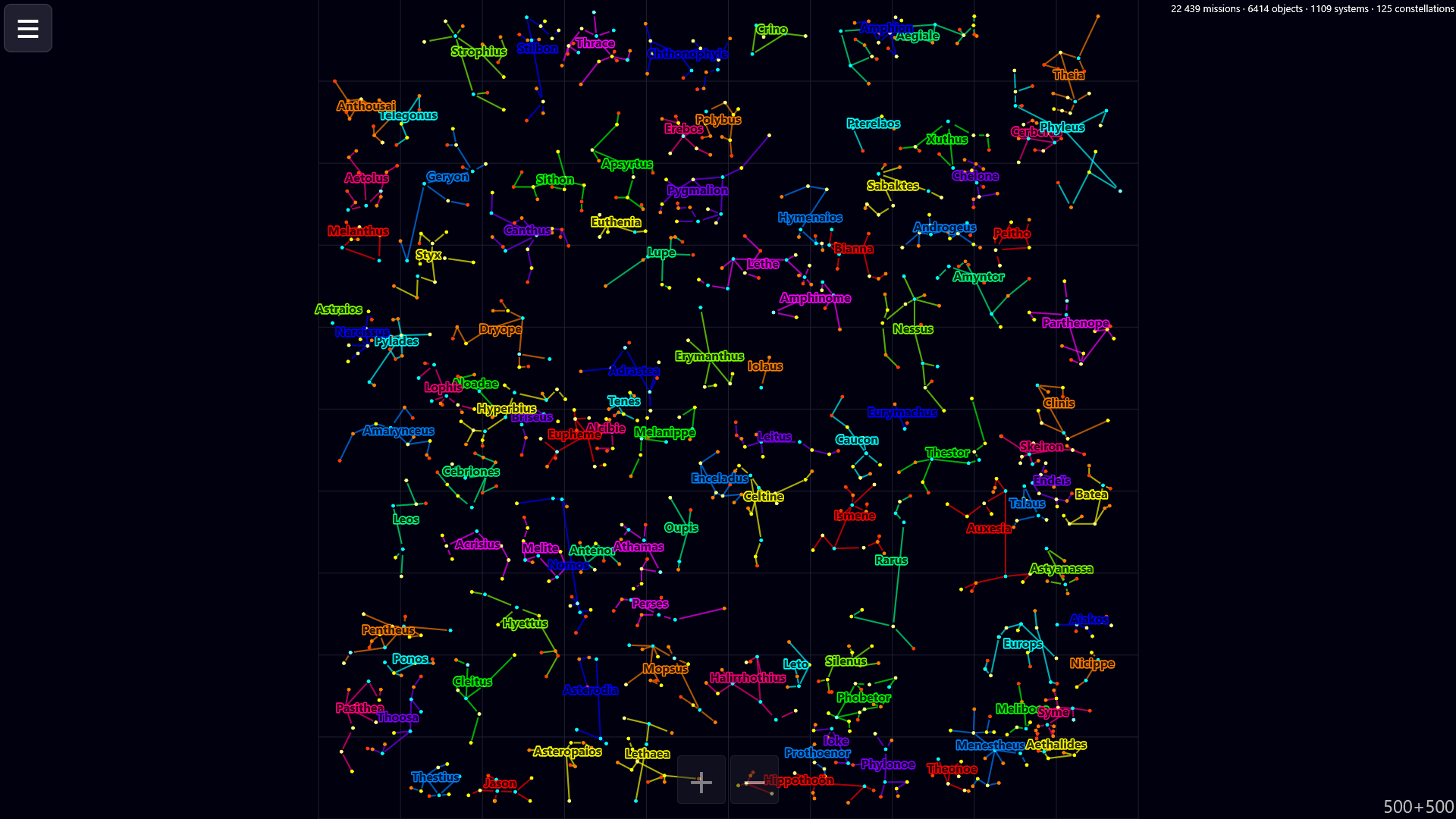
This is a complete recreation of the entire galaxy, down to every single planet and mission. It supersedes my previous Double Team and Key Rush maps. The data has been gathered with the help of @PlasmaX and @yaminozero.
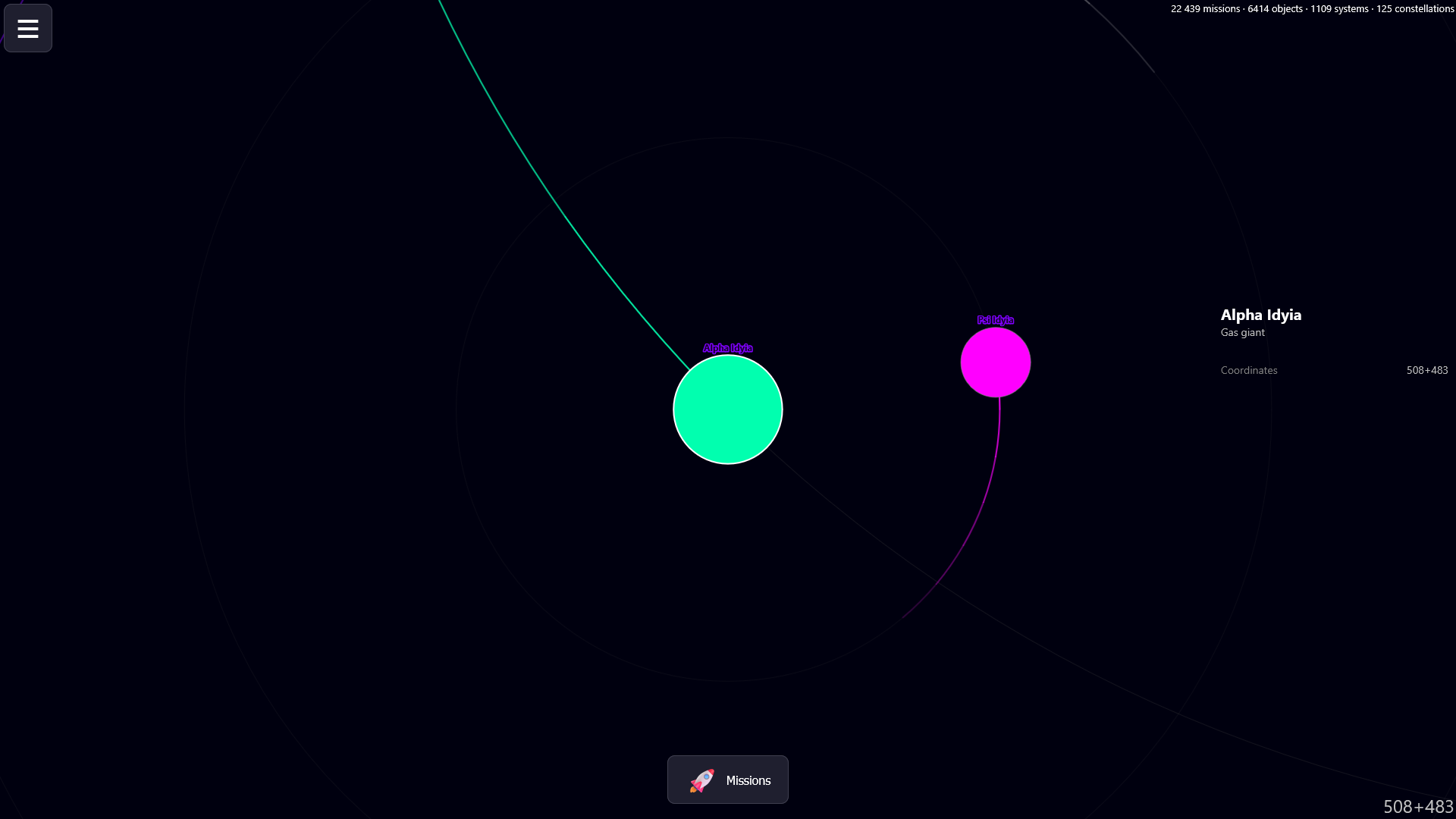
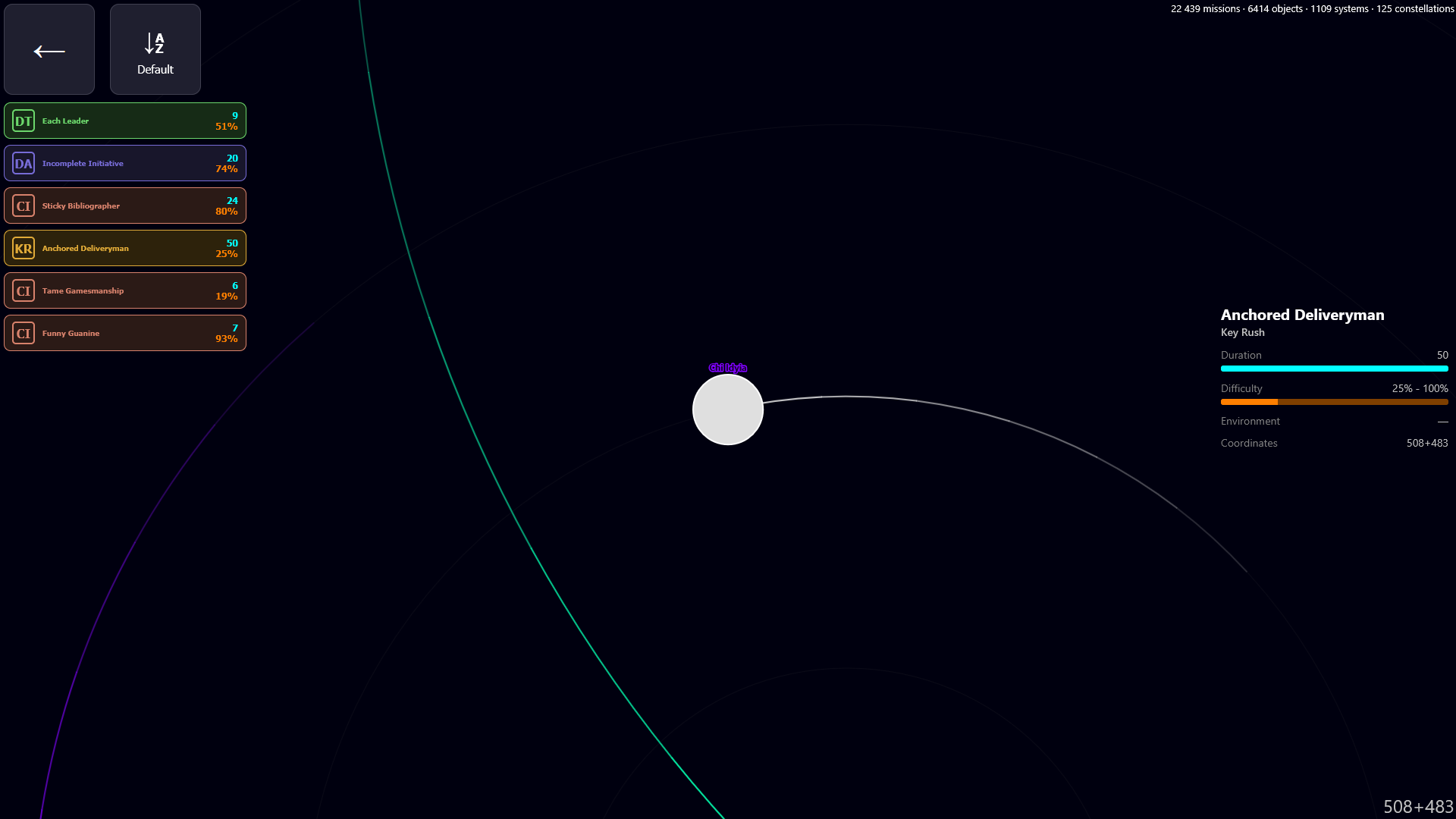
Missions are the primary focus, so most of the irrelevant data (rings, other planet stats) was not recorded. As for missions themselves, everything except for the tier requirement has been painstakingly noted down.
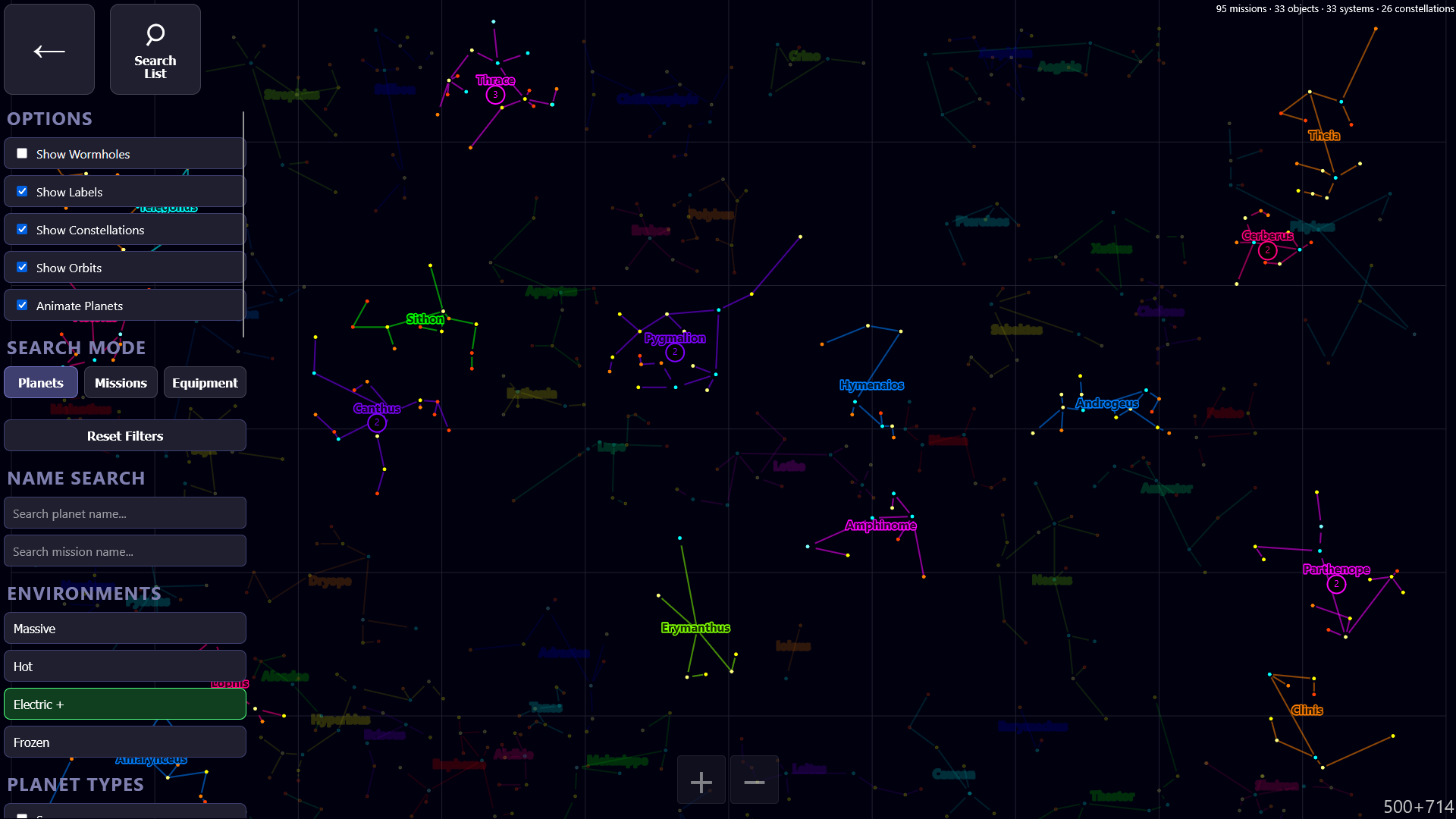
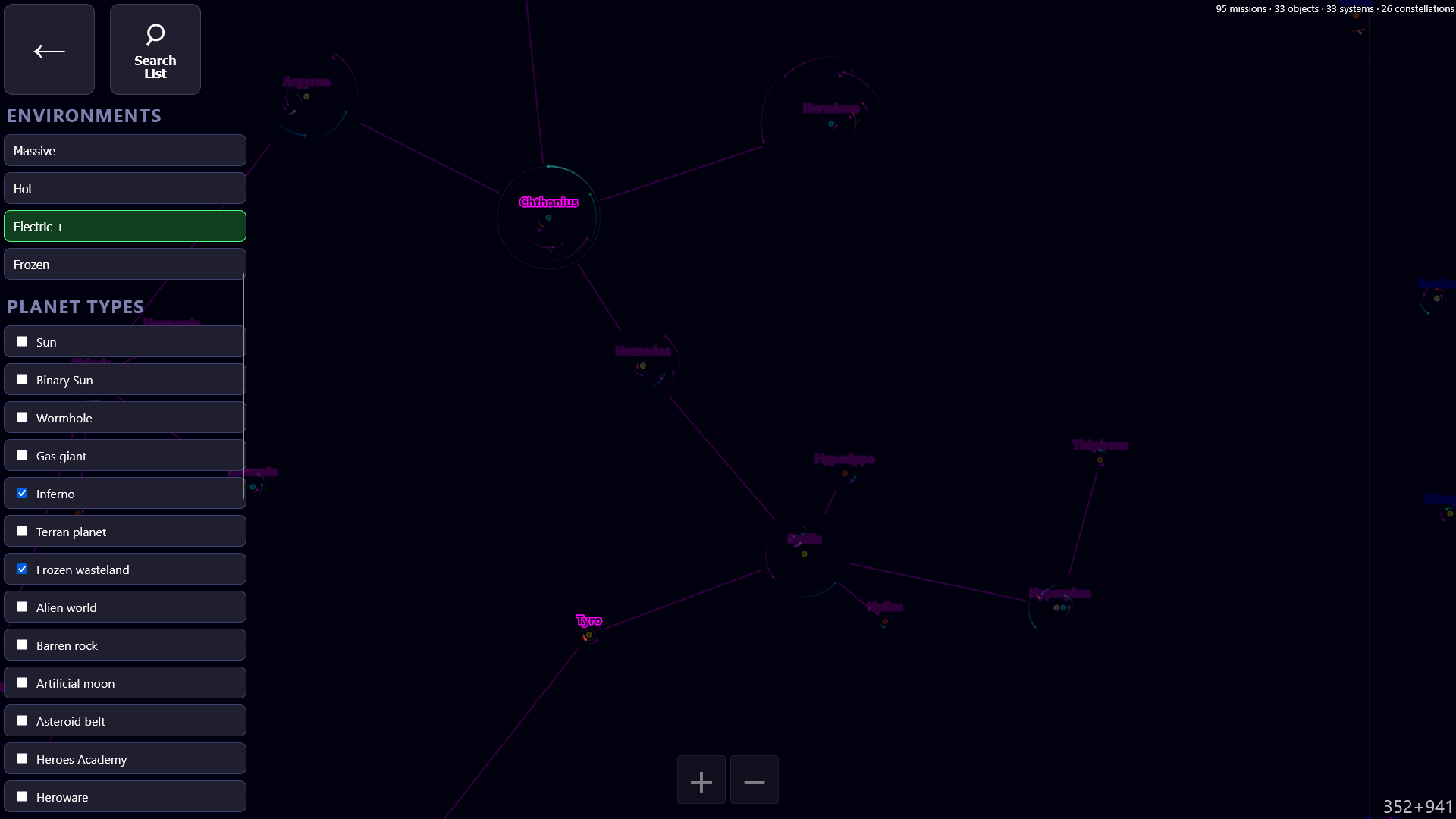
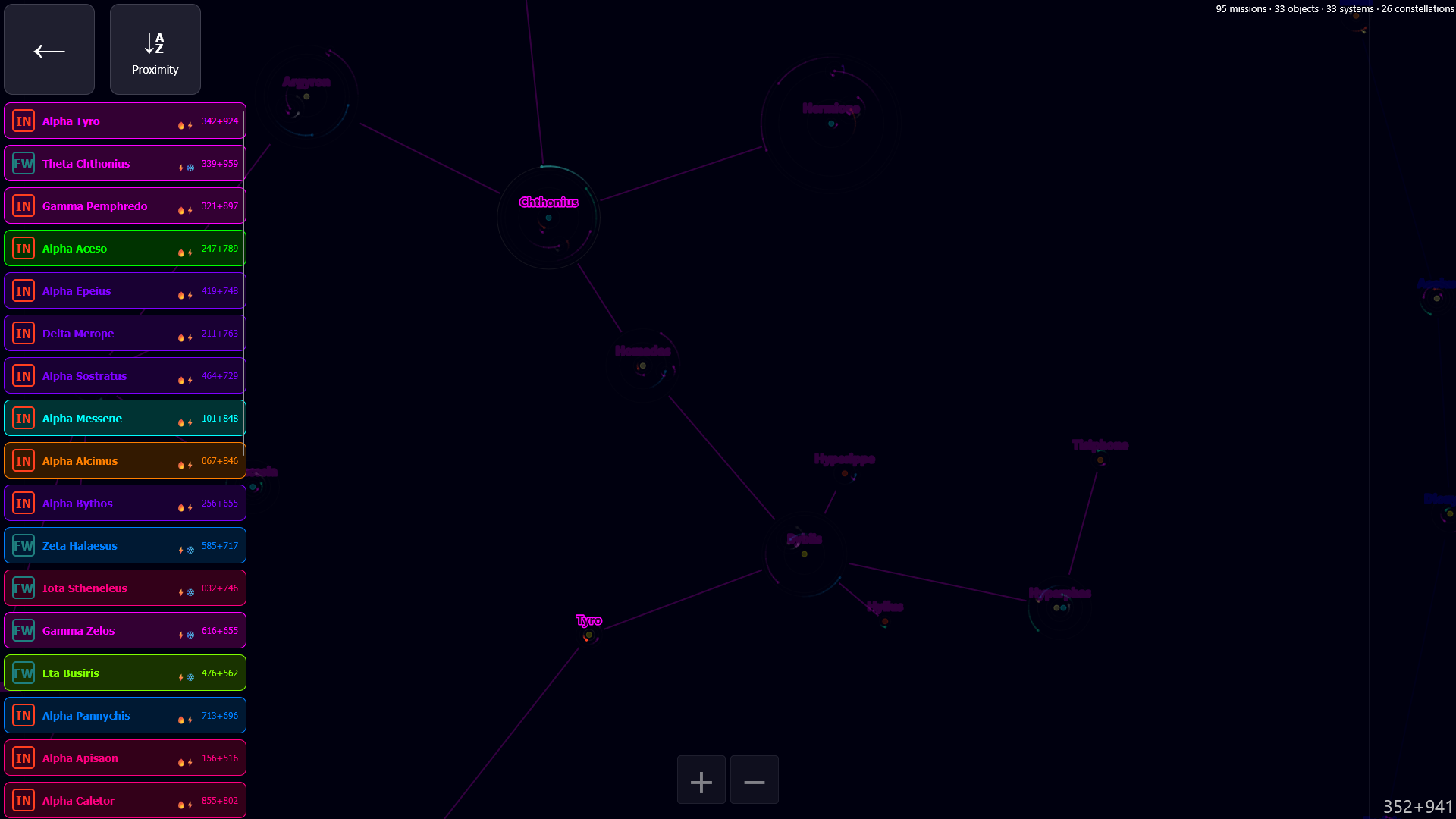
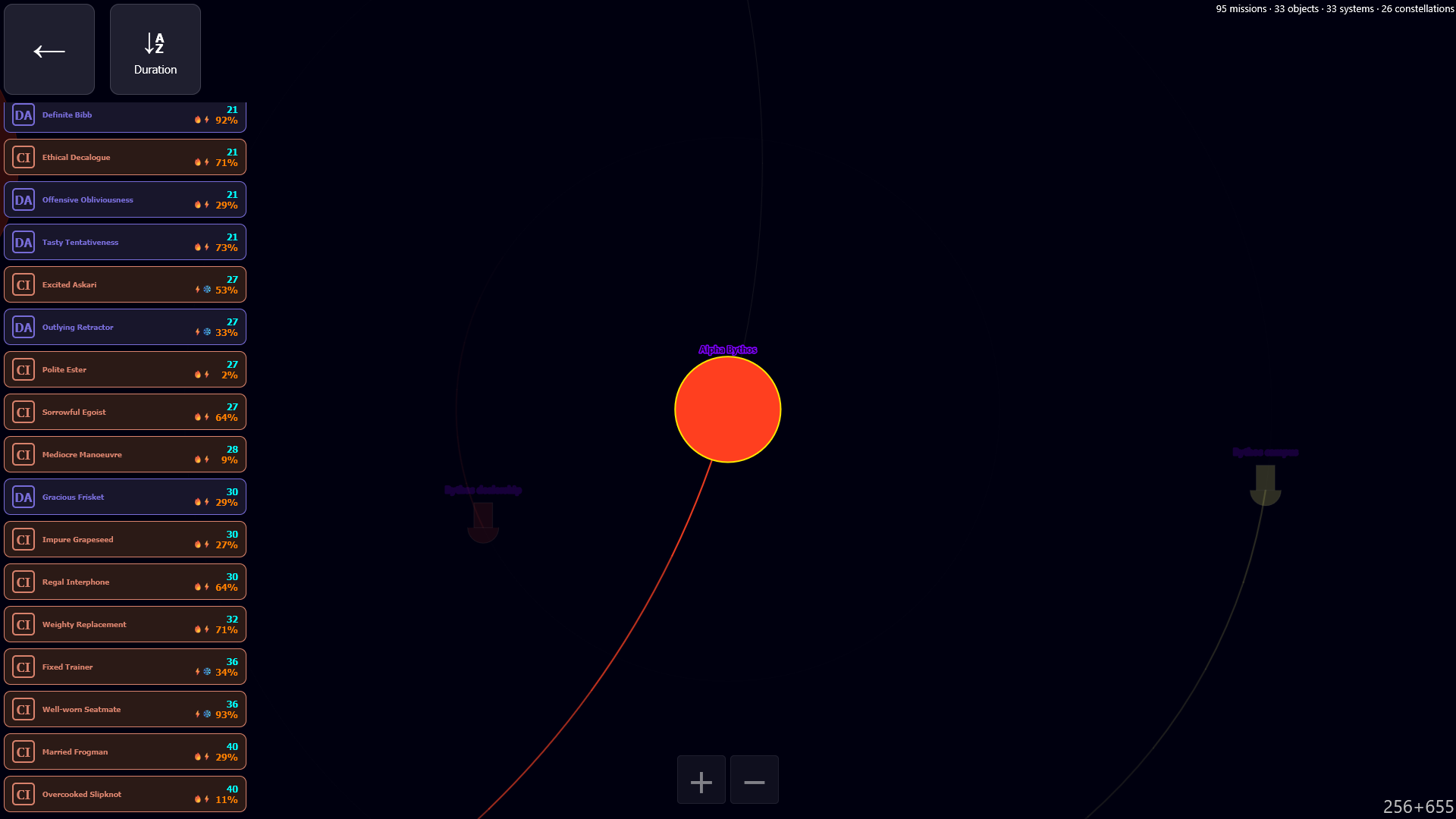
There are tons of planet and mission related search filters to find anything you can think of, as well as search lists containing all planets or missions that match, including a proximity filter to find those that are the closest to the current camera position.
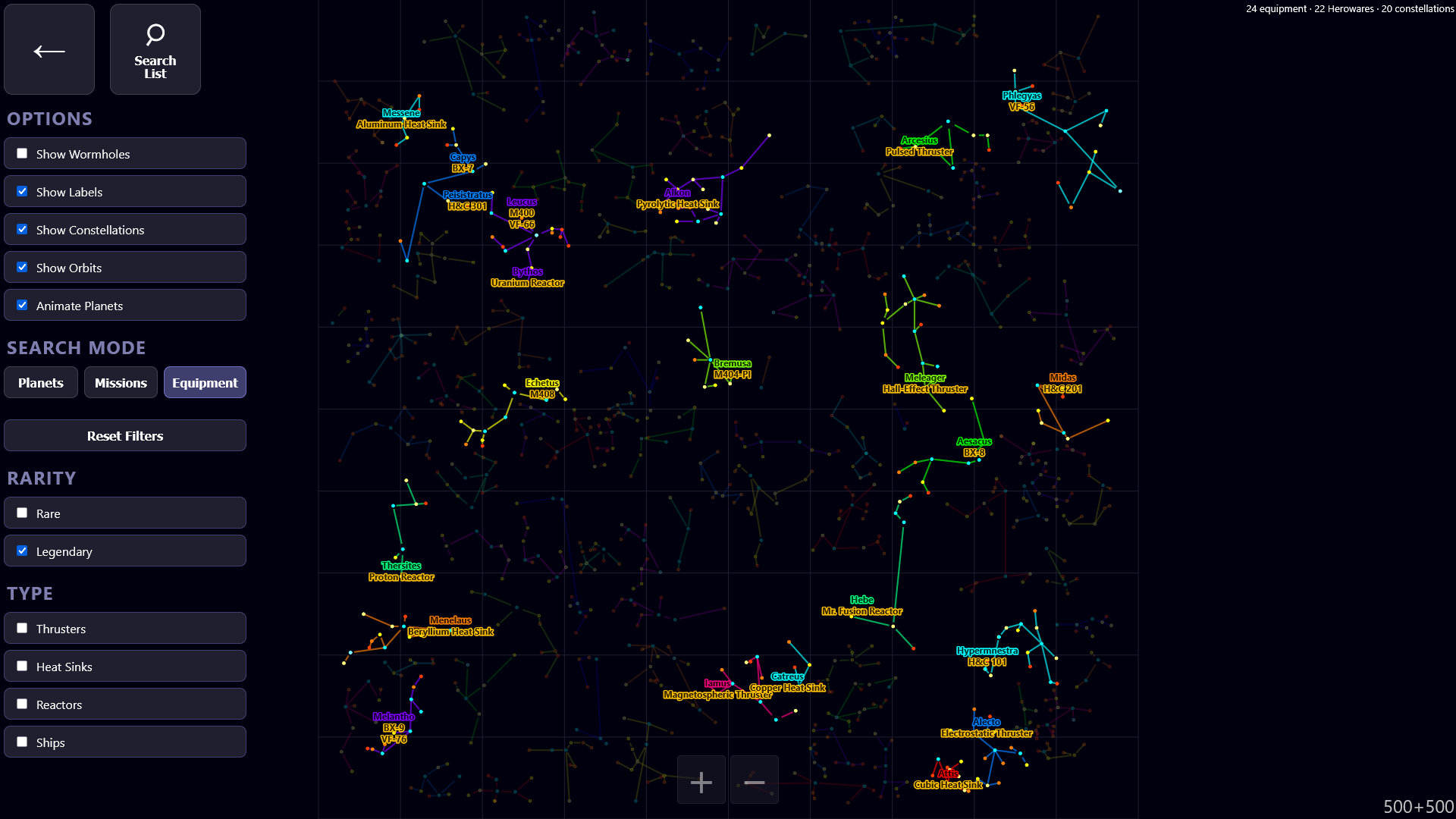
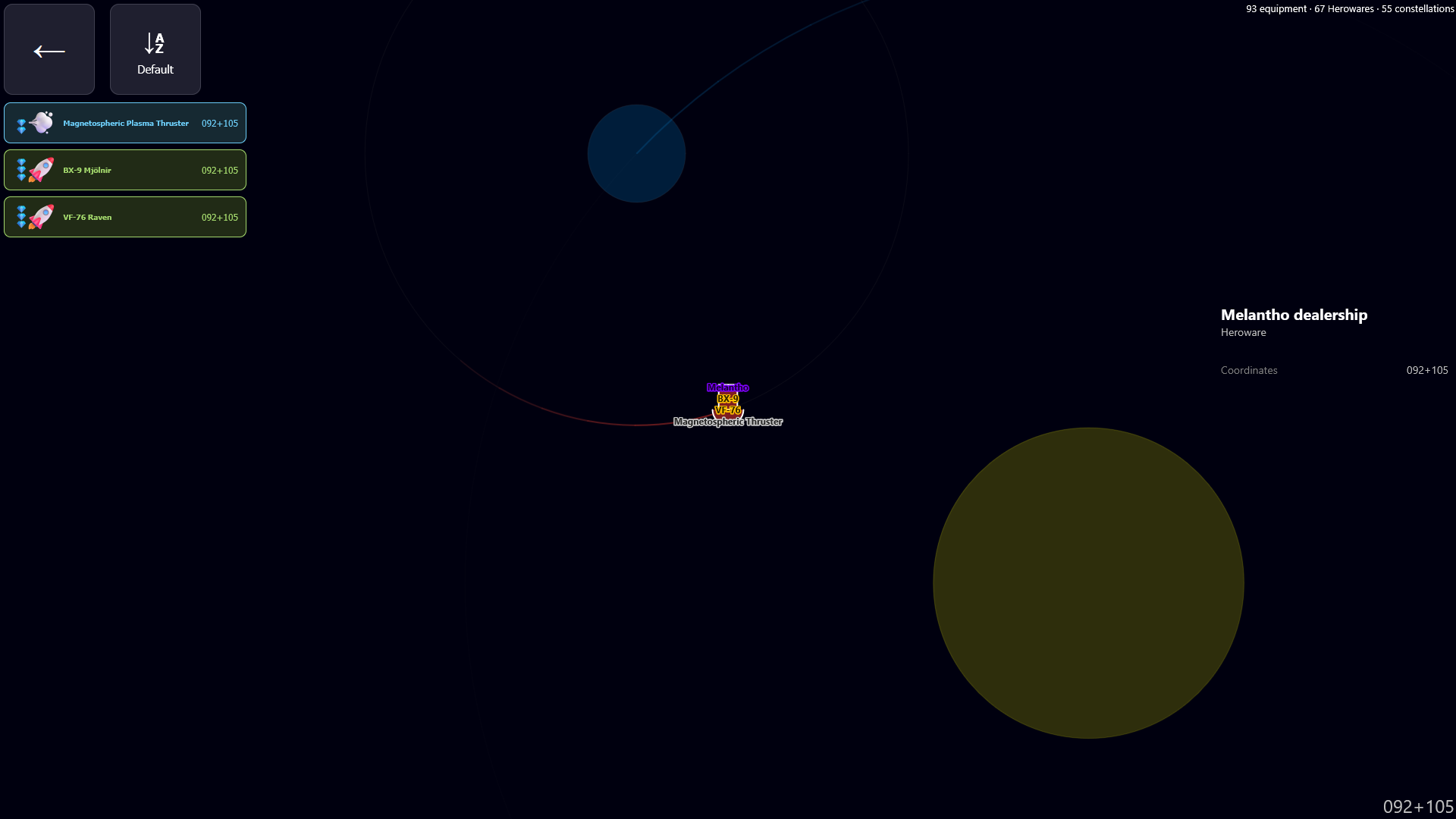
There is also integration with the Legendary tracking chart! The locations of rare and legendary equipment are all here, and each Heroware has a list of what’s present. This will work as long as people maintain that chart, otherwise nothing will be shown.
As it’s a webpage, the Galaxy Finder works on any device. It downloads around 2 MB of data upon startup, after which it can be used offline.
For those who just want the raw dataset, it can be found below.
The rest of this post will be dedicated to statistics and observations that I have made.
Planets
This is how many planets there are, for each type:
Primary objects:
Sun - 1080
Binary Sun - 18
Wormhole - 20
Planets:
Alien world - 1364, of which 128 are Electric
Gas giant - 701, of which 65 are Electric
Terran planet - 692
Inferno - 273, of which 21 are Electric
Frozen wasteland - 155, of which 12 are Electric
Asteroid belt - 100, of which 28 are Frozen and 34 are Hot
Moons:
Alien world - 515, of which 55 are Electric
Barren rock - 403, of which 30 are Electric
Artificial moon - 368
Shops:
Space Burger - 100, as well as 50 Droids
Others - 115 each
Only Alien worlds can be both planets and moons, and they by far dominate the list in both categories.
Most planets either don’t have any environment or always come with one (or two). Whether a planet is Electric or not is restricted to a few types, and only seems to be a roughly 10% chance.
On average, non-Wormhole star systems have 3 planets and one moon. There’s always an Alpha planet, except for when the spot gets taken up by an Asteroid belt. In general, star systems have 1-6 planets, and each planet may have up to 6 moons/shops.
There are 50 Droids in systems with Space Burgers, but they are only found in 33 systems, with many of them having two, or even three Droids in one system. The only constellation with Droids in two systems is Polybus.
Most planet types have 1-6 missions. Suns and Binary Suns have 2-9, but that’s because they first generate 1-3 Supernova missions on top of that. Droids have 3-7 and Wormholes have 2-10.
All planets except for Asteroid belts follow the same naming system, which uses the Greek alphabet, with regular planets going from the start, and moons going from the end.
The naming system for planets starts to break down when there are more than 13 objects in one star system, but there are only 7 such systems, with the biggest one (Lupa) having 19. In some cases it leads to an Omega planet/moon which is normally impossible, and there are 3 such planets/moons.
Asteroid belts have names unrelated to the systems they’re in, taken from a pool of names of Central African deities.
Wormholes have names from a pool of Siberian deities.
Space Burgers follow the naming scheme of “Restaurant #X”, where X is the result of some hash function. There are currently two numbers that repeat twice, which I have pointed out before: Restaurant #1921 and Restaurant #9197.
Gus’s Gas follows the naming scheme of “Outlet X.Y” where X and Y are its position in the galaxy multiplied by 30.
Some constellations lack certain planet types entirely:
Telegonus has no Gas giants.
6 constellations have no Infernos.
Astraios and Tenes have no Terran planets.
24 constellations have no Frozen wastelands.
9 constellations have no Barren rocks.
6 constellations have no Artificial moons.
Iolaus and Alcibie don’t have a single shop in them.
Missions
This is how many missions there are, for each type:
Chicken Invasion - 10720
Boss Rush - 2683
Supernova - 2189
Squawk Block - 2107
Comet Chase - 1311
Darkness - 1267
Feather Fields - 1061
Meteor Storm - 377
Double Team - 281
Droid Raid - 272
Retro - 127
Key Rush - 44
Other than the planet types with only a single mission type, they usually all have the same compositon of missions, it’s just that Darkness missions cannot appear on Suns/Binary Suns, Double Teams are restricted to Artificial moons, and Supernova missions are generated separately, as mentioned earlier.
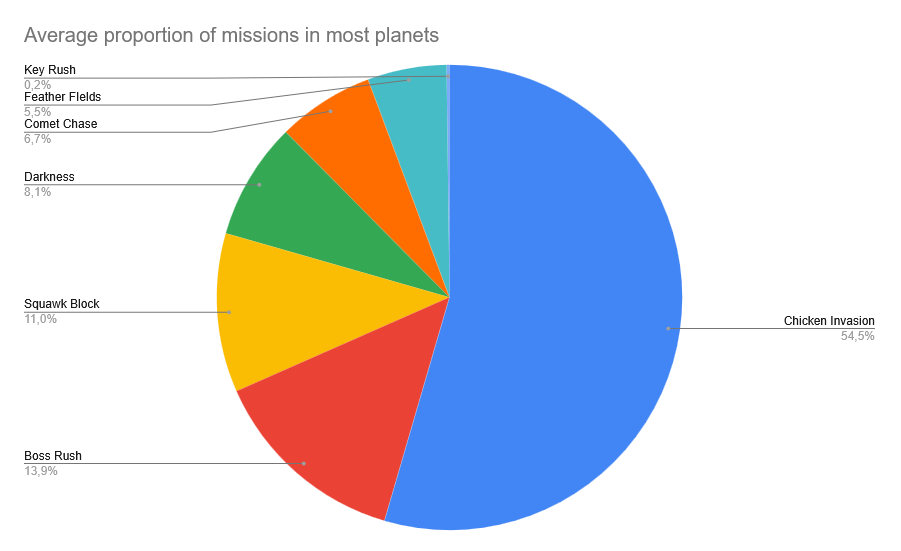
Most planet types have this distribution of missions.
Terran planets tend to have more Boss Rushes on average (15.6%) for some reason.
On Artificial moons, Double Teams make up 21.6% of missions, with the rest being the usual.
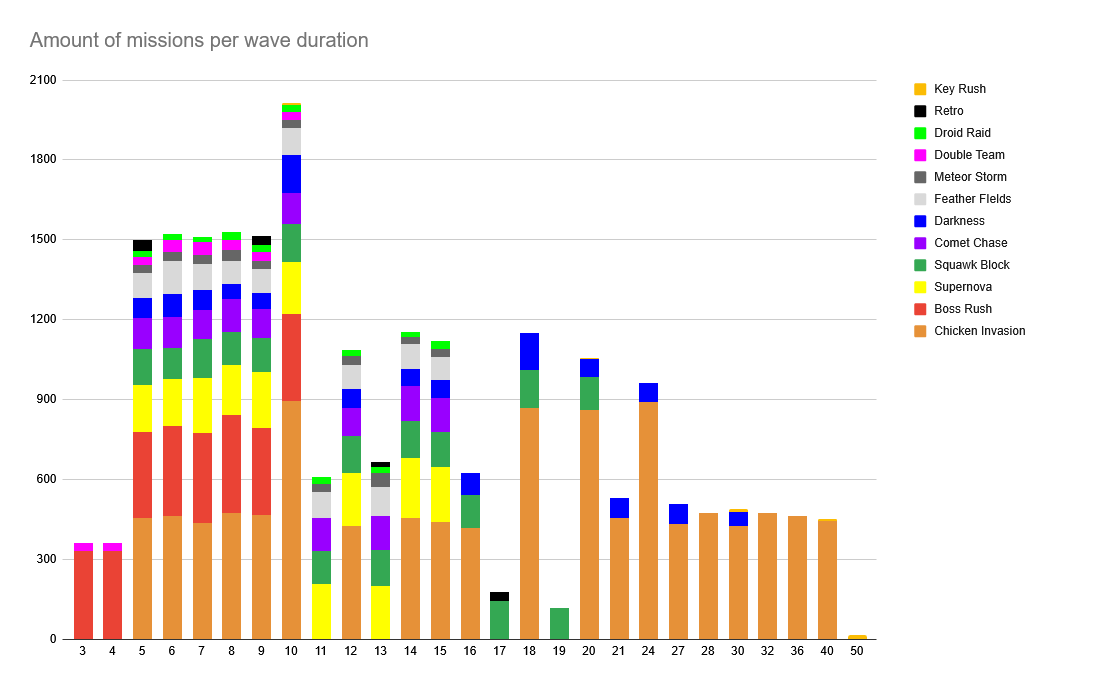
When it comes to mission durations, it’s split evenly for all possible durations each mission type has. Certain durations stand out due to having two combinations, for example 2x9 and 3x6 = 18, which results in double the usual amount of Chicken Invasions and Darkness missions. 50 wave missions are the rarest, since only Key Rushes can be that long.
The starting difficulties range roughly evenly from 0% to 99% (100% is impossible). The most common percentage is 25% with 259 missions, the rarest is 40% with 179. Double Teams are restricted to 50% or above, but their amount is negligible.
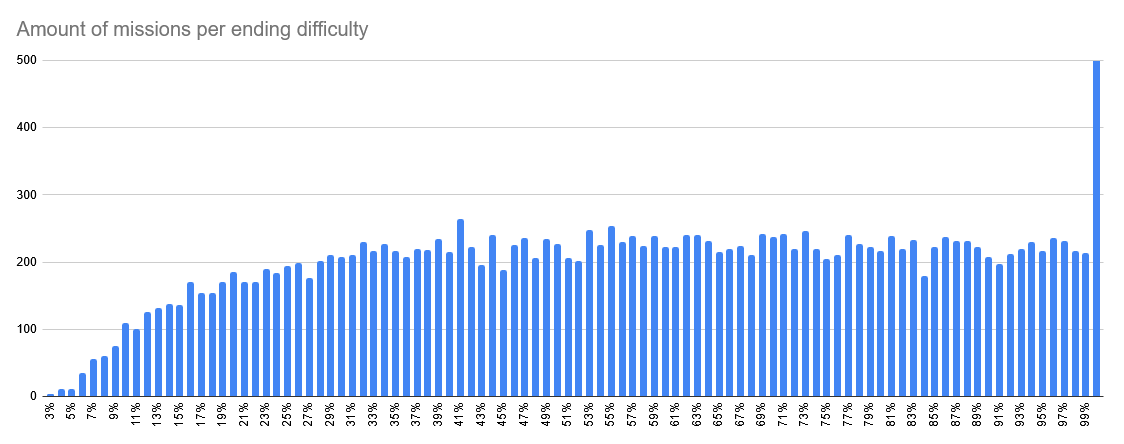
As for ending difficulties, 3250 missions get capped at 100%. Very few missions have 5% or less, with the amounts stabilising at 30% and above.
This is how many missions there are for each environment type:
None - 13639 (60.8% of all missions)
Massive + Hot - 5996
Hot - 1021
Electric - 945
Frozen - 616
Massive + Singularity - 127
Hot + Electric - 64
Frozen + Electric - 31
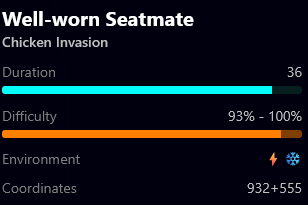
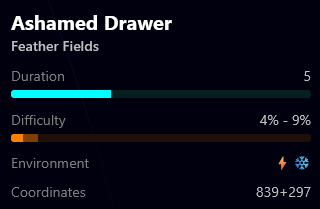
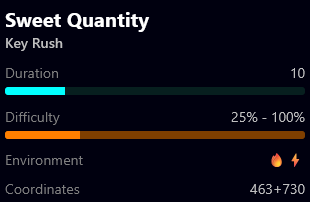
There are so few Hot + Electric and Frozen + Electric missions that it leads to a few one-of-a-kind missions: only a single Hot + Electric Key Rush, Frozen + Electric Comet Chase and Frozen + Electric Feather Fields.
Mission Names
All of the mission names follow the naming scheme of Adjective + Noun. There are 1324 unique adjectives and 1097 unique nouns.
There are only 3 instances of two missions having the same name (Clean Surmise, Illustrious Signature, Remote Barberry). The repeat is always a Droid Raid, which leads me to believe that iA ensured the planet mission names are all unique, with the exception of Droid Raids as these are generated dynamically.
The most common adjectives are Brisk, Agile and Testy at 31 missions each.
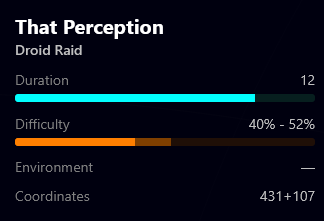
The rarest adjective is That, which only appears on one Droid Raid. It’s such a statistical anomaly that I think it might’ve been only available when it came to generating Droid Raids. Other than this, the rarest adjective is Unique at 5 missions. Each adjective is used 17 times on average.
The most common noun is Engine at 29 missions.and the least common is Midland at 13. Each noun is used 20 times on average.